
Content
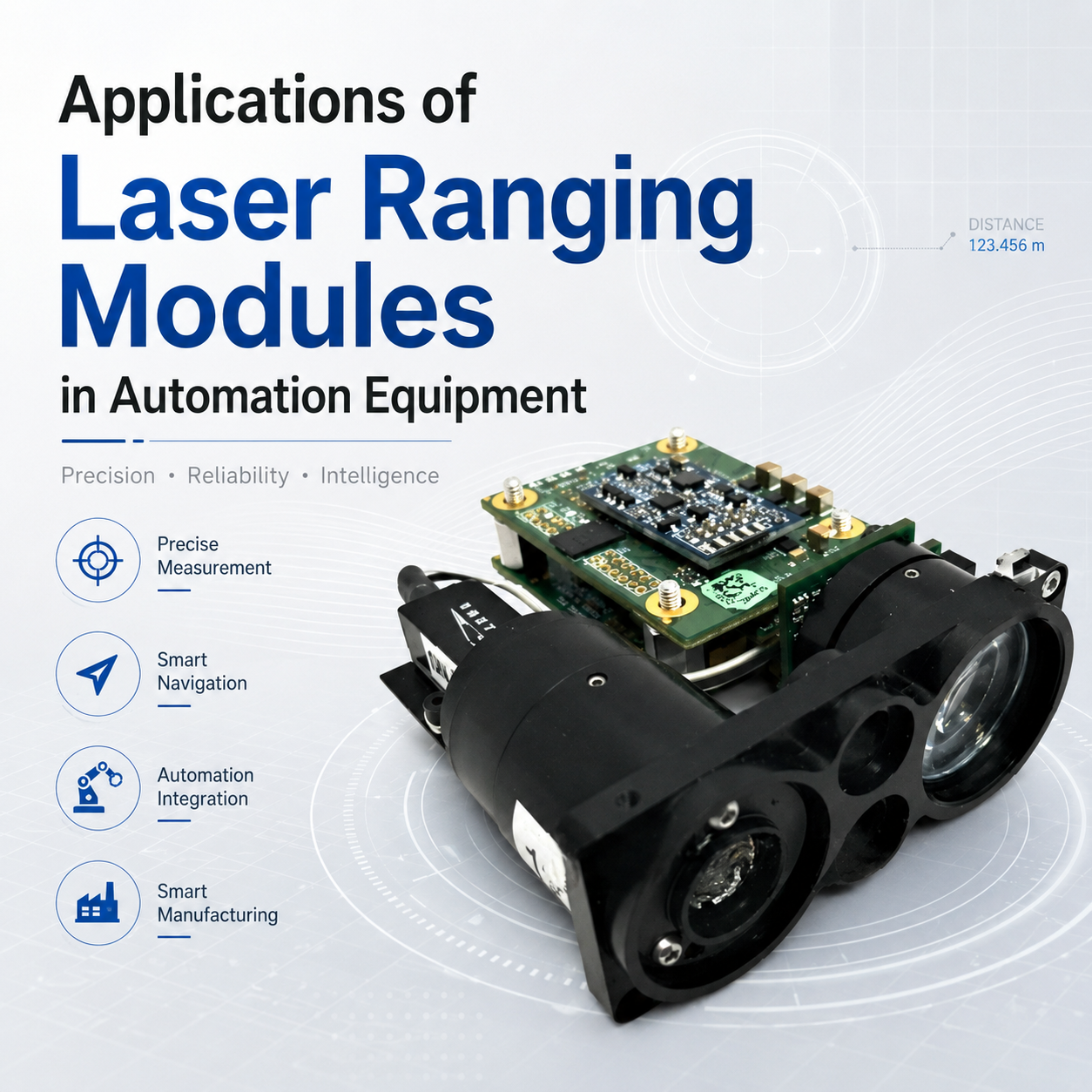
With the rapid development of industrial automation, accurate distance measurement has become increasingly important. Laser ranging modules are widely used in automation equipment because they can measure the distance between a sensor and an object by analyzing the reflection of a laser beam. Compared with traditional contact-based measurement methods, laser ranging offers higher speed, better accuracy, and reduced risk of mechanical interference.
Robot Navigation and Positioning
In robotic automation, laser ranging modules are mainly used for navigation, obstacle avoidance, and positioning. By collecting real-time distance data from the surrounding environment, robots can determine their distance from objects, walls, or obstacles. This information allows them to plan movement paths more accurately and avoid collisions during operation.
For example, in automated warehouses, AGVs — automated guided vehicles — use laser ranging technology to navigate precisely between shelves, other vehicles, and work areas. Through real-time environmental scanning, AGVs can automatically plan routes and complete material handling tasks efficiently and safely.
Measurement and Control on Automated Production Lines
Laser ranging modules are also highly valuable in automated production lines. They can be used for product size inspection, quality control, and position detection. For instance, laser sensors can measure the length, width, and height of workpieces on a production line to ensure that products meet required specifications.
In automated assembly processes, laser ranging modules help detect the position of components and ensure accurate alignment. This improves assembly precision, reduces production errors, and prevents defective products from entering the market.
Autonomous Driving Technology
Autonomous driving is one of the most important directions in automation technology, and laser ranging plays a key role in this field. LiDAR, which is based on laser ranging principles, is widely used in autonomous vehicles for environmental perception.
By scanning the surrounding environment, laser ranging systems help vehicles detect road conditions, obstacles, pedestrians, and other objects in real time. This technology provides accurate depth information, allowing autonomous driving systems to judge distances and make safe driving decisions.
Smart Warehousing and Logistics Systems
In smart warehousing and logistics, laser ranging modules are used for object identification, handling, stacking, and retrieval. Laser sensors can detect the exact position of goods and guide automated equipment to perform precise operations.
For example, AGVs and stacker cranes in automated warehouses use laser ranging modules to obtain the real-time positions of shelves and goods. This enables accurate material transportation, reduces manual intervention, and improves warehouse management efficiency.
Industrial Measurement and Detection
Laser ranging modules are also widely used in industrial measurement and inspection, especially in applications requiring high precision. They can be applied to dimensional measurement of precision machinery, height measurement of building structures, and distance-to-ground measurement in civil engineering.
Because laser ranging is a non-contact measurement method, it reduces human error and improves both measurement efficiency and accuracy. This makes it suitable for environments where traditional measurement methods are difficult, slow, or unsafe.
Conclusion
Laser ranging modules have made significant progress in automation equipment and are now used across many important industries. From robot navigation and smart warehousing to autonomous driving and precision measurement, they provide reliable distance data for intelligent systems.
As technology continues to develop, laser ranging modules will further improve the efficiency, precision, and safety of automation equipment. They will also continue to support the growth of smart manufacturing, intelligent logistics, and advanced automated control systems.