
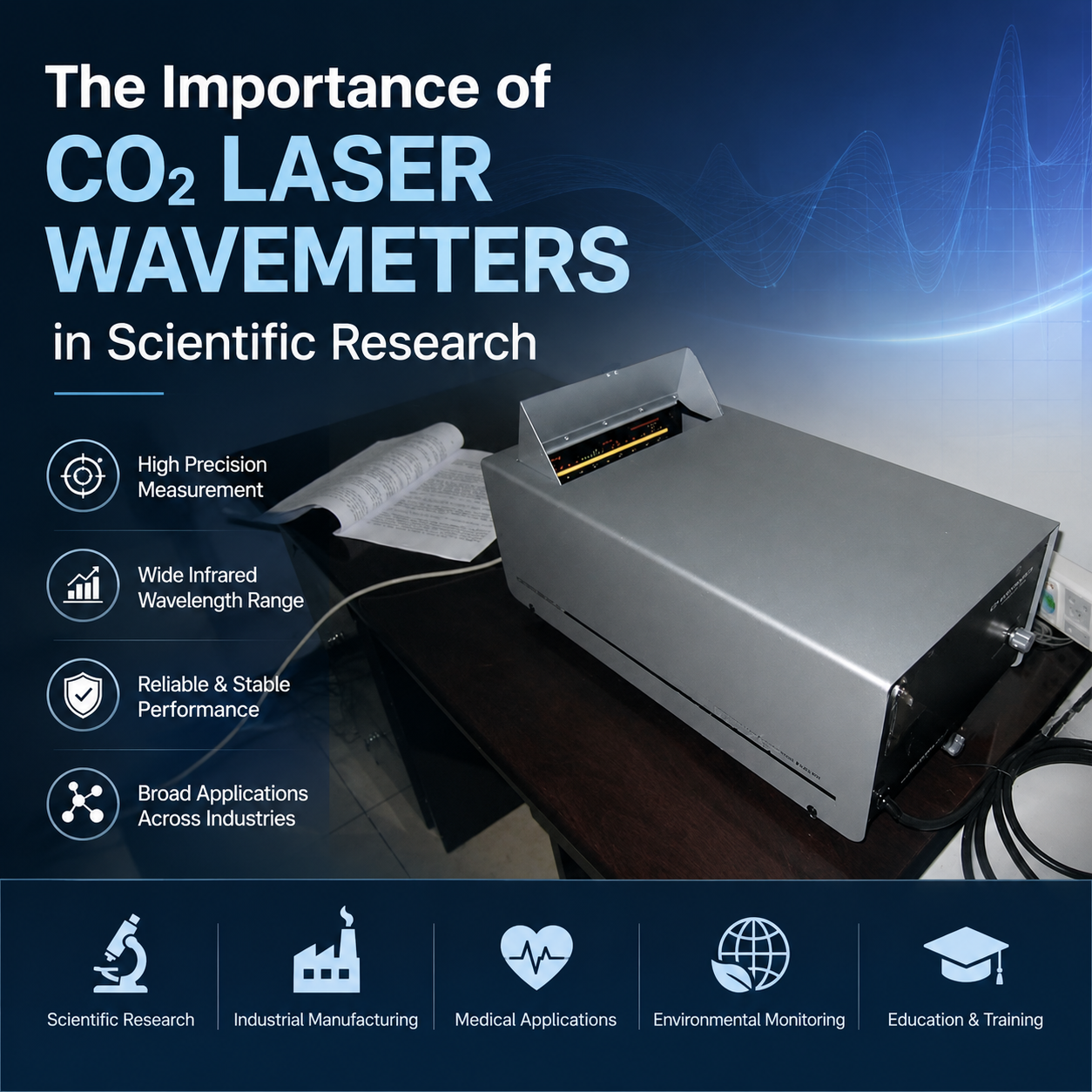
In modern scientific research, precision is essential. Whether scientists are studying molecular structures, developing advanced materials, or analyzing optical properties, accurate wavelength measurement plays a critical role. A CO₂ laser wavemeter is an important instrument designed to measure laser wavelengths with high accuracy, especially within the infrared spectrum.
CO₂ lasers typically operate in the wavelength range of approximately 9.4 μm to 10.6 μm, which falls within the infrared region. This wavelength range is especially valuable because many molecules can absorb infrared light. By using a CO₂ laser wavemeter, researchers can accurately identify molecular absorption peaks and gain deeper insights into the structure and properties of different materials.
In basic scientific research, CO₂ laser wavemeters are widely used in physics, chemistry, and materials science. Many experiments require precise control and measurement of laser wavelengths to ensure reliable results. This level of accuracy supports spectroscopy, optical analysis, and the development of new materials.
In industrial manufacturing, laser wavelength directly affects processing quality and efficiency. In applications such as laser cutting, welding, and machining, a CO₂ laser wavemeter helps monitor the working condition of laser equipment in real time. This allows companies to maintain stable production quality, reduce costs, and adjust process parameters quickly for different materials and thicknesses.
In the medical field, CO₂ lasers are commonly used in skin surgery, tumor removal, and minimally invasive procedures. Accurate monitoring of wavelength and power helps doctors improve surgical safety and effectiveness. By controlling the laser wavelength precisely, medical professionals can reduce damage to surrounding tissue and improve patient recovery outcomes.
CO₂ laser wavemeters also play a valuable role in environmental monitoring and climate research. As global warming and air pollution become increasingly serious, scientists need accurate tools to measure greenhouse gases such as carbon dioxide. CO₂ laser wavemeters can detect light absorption at specific wavelengths, providing highly sensitive data for gas concentration measurement. This information supports climate change research, emissions assessment, and environmental policy development.
In education and research institutions, CO₂ laser wavemeters serve as practical teaching and research tools. They help students and researchers understand laser principles, measurement techniques, and real-world applications. This hands-on experience supports the training of future scientists and engineers.
Overall, CO₂ laser wavemeters are indispensable tools in scientific research and related industries. Their ability to deliver accurate wavelength measurements makes them valuable in laboratory research, industrial production, medical technology, environmental monitoring, and education. As technology continues to advance, the applications and impact of CO₂ laser wavemeters will continue to expand.